We treated our trip to Częstochowa like a mini pilgrimage to visit the "Black Madonna of Poland". I must say that we were a little fortunate as most tours from Krakow to Częstochowa do not operate on Thursdays.
We managed to organise our trip with some help from our hotel staff, at a cost of PLN 260.00 per person. To our surprise, we were the only ones going. Our driver, Yanush gave us a good introduction to Częstochowa and we also watched a video on our way.
The journey from Krakow took about 3 and a half hours (one-way). According to Yanush, when Pope John Paul II celebrated mass in Częstochowa, more than one million Catholics attended. There were not many pilgrims when we were there, but mass was in full attendance.
 Statue of Cardinal Wyszyński
The 'Black Madonna' is in essence an icon of the Virgin Mary. According to a famous legend, the icon was painted by St. Luke the Evangelist on a tabletop built by Jesus himself, and the icon was discovered by St. Helen, mother of Emperor Constantine and collector of Christian relics in the Holy Land. The icon eventually found its way into Poland in 1382.
 The icon of Our Lady of Częstochowa (during Mass)
 The icon is only revealed during mass and a scroll will cover the icon after mass. It was a beautiful service even though we don't understand Polish. The mass was dedicated to a group of Paulinean monks. According to Yanush, the church always have masses dedicated to a particular cause or profession e.g. masses dedicated to firemen, doctors etc.
 The icon of Our Lady of Częstochowa (after Mass)
After mass, we toured around the museum which showcase the story of the Black Madonna and a history Częstochowa. We also bought some souvenirs and took some shots outside the church.
 Monks and priests get together after mass
 A scene from the monastery of Jasna Góra
Yanush took a different route on our way back to Krakow, via some country road and passing the Ojców (pronounced 'OUT-Soof') national park, which was surrounded by limestone caves formed during the Jurassic period. We managed to take a look at the little church built on water there.
 Little church built on water
 Front view of the little church on water From what I understand, the church was built on water because during that time, the Poles didn't have the permit to build the church on land. Technically, by building the church on water, the Poles did not violate any laws.
We finally arrived in Krakow at about 3.30 pm in the afternoon and proceeded to take a rest after lunch.
Dinner
We had early dinner and cakes for dessert at Carlito (www.restauracjacarlito.pl), a restaurant located within the Old Town Square between the Florian Gate and the Mariacki Church.
 Cakes at Carlito
 Old Town - Scene taken on the way to the Florian gate
Budapest, here we come!
After dinner, we headed to the hotel and board a taxi to Krakow Glowny train station to board our train to Budapest-Keleti. We bought a sleeper reservation, which cost EUR 21 per person (since we already got a Railpass) to get ourselves into a private cabin.
 Krakow Glowny station (front) at night
 Sleeper reservation to accompany our Rail Pass
Our cabin was quite comfortable and we were able to get a good night's sleep until we arrived at Budapest the next morning. The sleeper cabin can be configured to sleep three. I took the upper bunk of course.
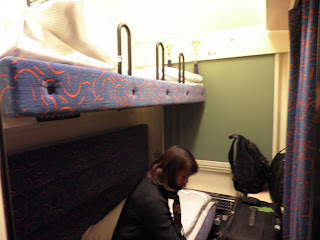 A view of our Sleeper cabin
 That's me on the upper bunk
 Monks and priests get together after mass
 A scene from the monastery of Jasna Góra
Yanush took a different route on our way back to Krakow, via some country road and passing the Ojców (pronounced 'OUT-Soof') national park, which was surrounded by limestone caves formed during the Jurassic period. We managed to take a look at the little church built on water there.
 Little church built on water
 Front view of the little church on water
 We finally arrived in Krakow at about 3.30 pm in the afternoon and proceeded to take a rest after lunch.
Dinner
We had early dinner and cakes for dessert at Carlito (www.restauracjacarlito.pl), a restaurant located within the Old Town Square between the Florian Gate and the Mariacki Church.
 Cakes at Carlito
 Old Town - Scene taken on the way to the Florian gate
Budapest, here we come!
After dinner, we headed to the hotel and board a taxi to Krakow Glowny train station to board our train to Budapest-Keleti. We bought a sleeper reservation, which cost EUR 21 per person (since we already got a Railpass) to get ourselves into a private cabin.
 Krakow Glowny station (front) at night
 Sleeper reservation to accompany our Rail Pass
Our cabin was quite comfortable and we were able to get a good night's sleep until we arrived at Budapest the next morning. The sleeper cabin can be configured to sleep three. I took the upper bunk of course.
 A view of our Sleeper cabin
 That's me on the upper bunk


